
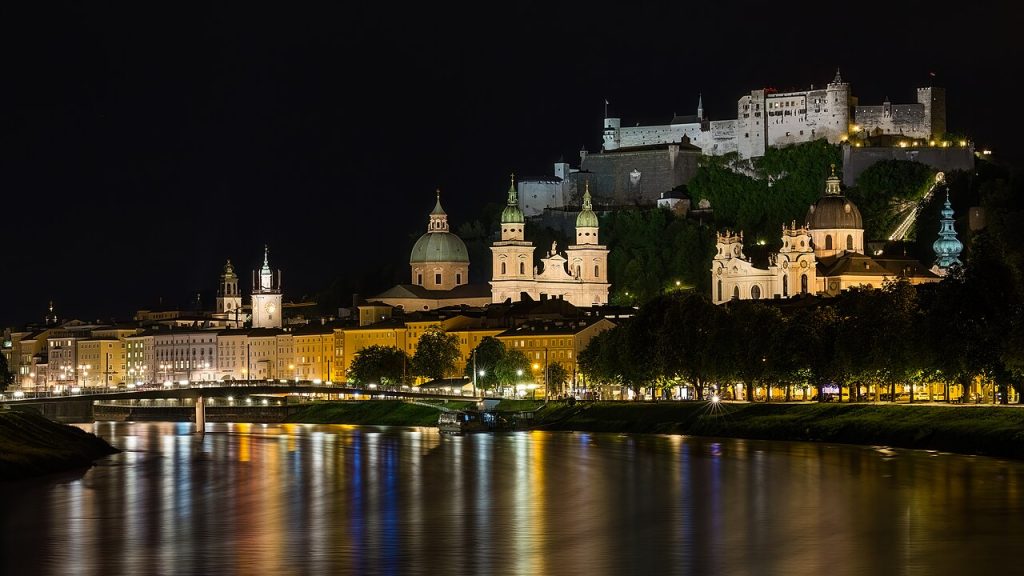

After dark, Salzburg is a walking city with the lights left on for you. The shops close around six, the lanes thin out, and the city floodlights its town hall, its churches and part of the Mönchsberg cliff. A walk of about 2.3 km, from the Waagplatz through the old town, across the river and up the Linzer Gasse, takes in most of it in about 90 minutes, on streets mapped as lit and with no mapped steps. Here is what you can see, what is open, and what to watch your footing for.
When it gets dark, and when the lights go off
Sunset in Salzburg is about 16:19 in late December, 18:21 in mid-October and 21:12 in late June, and civil dusk ends 30 to 40 minutes later. In the narrow lanes under the Mönchsberg it probably feels dark sooner than that.
The floodlights do not burn all night. Local press reports put the switch-off at about 23:00 from November to March and about midnight from April to October, with August a little later. That is our reading of two news articles, not a published timetable, and the city also turns the lights off for events such as Earth Hour. The street lamps are LED and, according to the city’s head of public lighting, are dimmed in steps through the night. In practice: start an hour after sunset and you will see the buildings lit.
What is lit
The city’s list of floodlit objects, as reported in 2022, includes the cathedral, St. Peter’s church, the Kollegienkirche on Universitätsplatz, the Old Town Hall, the Glockenspiel, the Mozart monument, the Michaelitor gate, the Neutor and the horse pond, St. Mark’s church in the Gstättengasse, the Mönchsberg wall, St. Sebastian’s church, the Holy Trinity church, Mirabell Palace, and the footbridge now called the Marko-Feingold-Steg (renamed in 2021, formerly Makartsteg).
Hohensalzburg Fortress is not named on that list, and we could not confirm from a first-hand source when it is lit, so we will not promise it.
Some places you might expect to glow do not: the painted front of Waagplatz 1, the Bürgerspital and the mosaic at the old witches’ tower site are lit only by street lamps or wall lanterns.
An evening route through the old town
This is the route of our Salzburg After Dark audio guide, which tells the city’s darker history: its courts, the sorcery trials of the late 1600s, the plague years and a rockfall. The streets are public, so you can walk them with a map and your own thoughts just as well.
The Waagplatz and the Judengasse
Start on the Waagplatz, about 140 meters from the Mozart statue. The square has been car-free since July 2025 and is paved with new granite slabs. Turn into the Judengasse, a narrow, level, lit lane of small shops. Walk west and the white town hall tower appears above the end of the lane.
The Old Town Hall and Universitätsplatz
From the mouth of the Sigmund-Haffner-Gasse you see the Old Town Hall front floodlit, with the figure of Justice in her niche above the door. Then go through the Ritzerbogen, a public street arch, onto Universitätsplatz, where the Kollegienkirche’s pale front is floodlit.
The horse pond, the Bürgerspital and the Gstättengasse
At Herbert-von-Karajan-Platz the horse pond and the Neutor are floodlit. Expect building-site fences around the square until the festival works end. North under the cliff, the Bürgerspital, the old citizens’ hospital, has wall lanterns and an archway into its arcaded courtyard. We found no published hours for that courtyard, so treat it as a bonus.
The Gstättengasse runs on under the rock to St. Mark’s church, which is floodlit against the cliff. In 1669 part of the Mönchsberg fell here in the middle of the night, and a plaque on the church records the dead. The city still employs cliff cleaners who abseil down the rock to clear loose stone. Their rope calls, “Hauser” and “Jager”, are said by the trade to be named after two of the first men to do the job; that is their own tradition, and we found no record that confirms it.
Along the river to the Staatsbrücke
Follow the Franz-Josef-Kai along the Salzach to the Staatsbrücke. From the bridge you can look back at the town hall tower and the fortress above the old town, and downstream to the Marko-Feingold-Steg and St. Mark’s under the cliff.
The Linzer Gasse and the witches’ tower corner
Across the bridge, the Platzl leads into the Linzer Gasse, a pedestrian lane that climbs about 8 meters past the floodlit front of St. Sebastian’s church. At the corner of Paris-Lodron-Straße and Wolf-Dietrich-Straße, a dark mosaic and a small plaque mark the site of the Hexenturm, the “witches’ tower”. The plaque speaks of persecuted women. The trial records show the tower was a prison for only about a year, from the summer of 1678 into 1679, and that most of those executed in the trials were children and young people, more than two thirds of them male and nearly all from the begging poor. The Mirabellplatz bus stops are about 270 meters away.
What is open in the evening
- The Mirabell gardens, free, until 22:00 from October to April and 23:00 from April to September, as published by the City of Salzburg on 8 October 2026. Some parts close in winter. Mirabell Palace itself is floodlit.
- The fortress, in summer. As published on 8 October 2026, it is open until 20:00 from May to September and until 17:00 the rest of the year. From May to September the museums close at 19:00, and the courtyards and bastions stay open until 20:00. The FestungsBahn funicular runs later than the fortress for part of the year (in October the last ride up is at 20:00 and the last ride down at 20:30, by the operator’s page), so check what is open at the top before you ride up. Check the fortress’s hours and the funicular’s times before you plan around them.
- Restaurants and bars. The Gstättengasse has pubs and clubs listed as open until 2:00 or later at weekends. Expect noise and groups there on Friday and Saturday nights.
- Not open: St. Peter’s Cemetery (it closes at 18:00 from October to March and at 20:00 from April to September), most church interiors, and the covered passages off the Getreidegasse, which have no published evening hours.
Practical notes for an evening walk
- Lighting. Every street and square on the route above is tagged as lit in OpenStreetMap. The sidewalks at the last junction, by the witches’ tower site, carry no lighting tag.
- Wet stone. Granite slabs, setts and paving stones are slippery when wet or icy, especially on the Linzer Gasse climb.
- Crossings. Two crossings with traffic lights at Herbert-von-Karajan-Platz, two without lights across the Franz-Josef-Kai by the Haus der Natur museum, one with lights from the Staatsbrücke to the Platzl, and a zebra crossing at the end. Trolleybuses run on several of these roads.
- Bikes. Cyclists share the downstream path of the Staatsbrücke and may ride both ways in the Linzer Gasse.
- Help. The European emergency number, 112, works in Austria.
- Getting back. Buses leave from the Mirabellplatz. Map data shows a taxi rank by the Haus der Natur from 22:00 to 4:00.
What we cannot tell you
We cannot tell you how busy a lane will be on your night, how dark the side streets get after the lamps are dimmed, whether a courtyard gate is open, or whether a facade is behind scaffolding. Our notes come from map data, the city’s lighting list as reported in the press, opening hours as published on the dates given, and dated night photographs. Use them as a starting point and your own eyes on the night.
Where to go from here
If you would like the stories that go with this route, Salzburg After Dark is made for exactly this walk, and How it works explains what you get on your phone. For daylight, Salzburg Essentials, Across the River and Hohensalzburg Fortress cover the old town, the right bank and the fortress, and you can see all our Salzburg tours with a map of their start points. If you have the whole day, our one-day plan for Salzburg on foot ends with this walk. Or simply walk out after dinner and look up.