

Content note. This article describes persecution, deportation and murder under the Nazi regime, including the murder of a teenager and of sick and disabled people. It does so without graphic detail.
Salzburg went to war in 1939 as part of Nazi Germany. Local Nazis took over the governor’s office and the town hall on the evening of March 11, 1938, and German troops crossed the border the next morning. Over the next seven years the regime drove out and robbed Salzburg’s Jews and murdered many of them, and persecuted Sinti, sick and disabled people, political opponents and others. American bombing raids hit the city from October 1944, and on May 4, 1945, it was handed over to US troops without a fight.
To understand 1938 you have to start earlier. We report what the sources show and say so where historians disagree.
Before 1914: a provincial city of the monarchy
- 1816. Salzburg comes to Austria for good, at first as a minor district run from Upper Austria. It becomes a crown land of its own around the middle of the century.
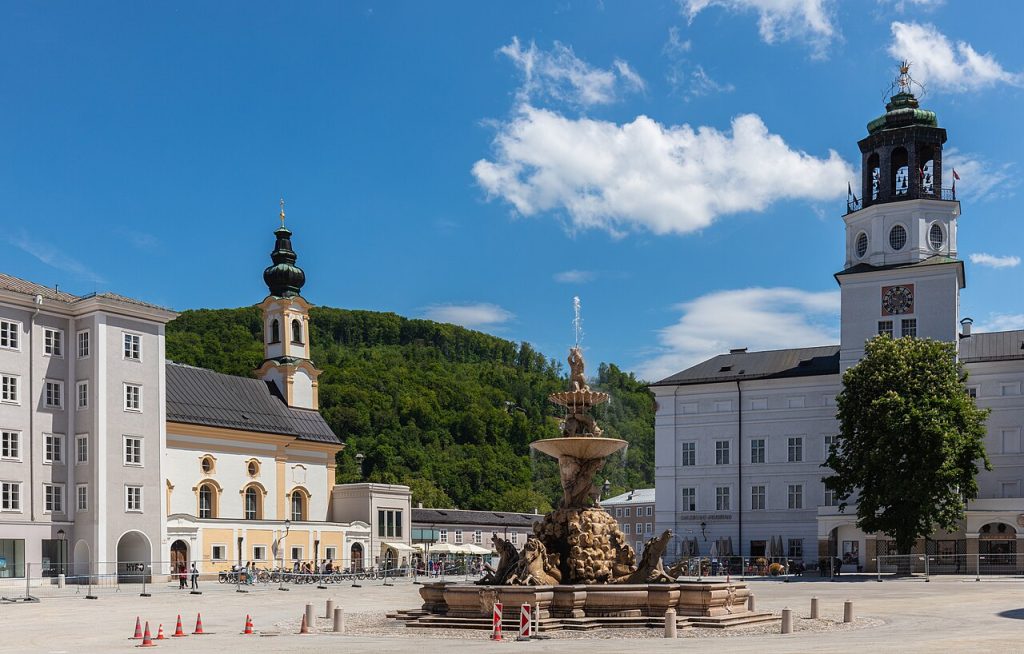
- By the end of the monarchy the emperor’s governor sits in the Neue Residenz, the long white building with the Glockenspiel on the Residenzplatz.
1914 to 1918: Sarajevo and the First World War
- June 28, 1914. In Sarajevo, Gavrilo Princip, a 19-year-old member of the group Young Bosnia, shoots the heir to the throne, Archduke Franz Ferdinand, and his wife Sophie. In Salzburg, the provincial archive’s director writes, it had been “a quite normal summer Sunday” until the news arrived.
- July 28, 1914. Emperor Franz Joseph signs the declaration of war on Serbia at Bad Ischl. Historians still disagree about who carried the most responsibility for the war.
- 1915 to 1918. Food is rationed from 1915. By the end of 1917 the city alone has lost 307 men.
- September 19, 1918. About 4,000 hungry people gather on the Mozartplatz. Stones break the windows of the governor’s building, and food stores and hotels are looted.
1918 to 1921: the end of the monarchy and the treaty
- November 11–12, 1918. Emperor Karl renounces any share in government. The next day German-Austria is proclaimed a republic and declared part of the German Republic.
- September 10, 1919. Austria signs the Treaty of Saint-Germain: a small state of 6.5 million people, without South Tyrol, renamed “Republic of Austria” and barred by Article 88 from giving up its independence without the League of Nations’ consent.
- May 29, 1921. In a vote with no legal force, about 99 percent of those voting in the province back joining Germany. Recorded figures differ slightly. Allied pressure stops further votes.
1922 to 1937: crisis, dictatorship and Nazi terror
- 1922 to 1934. Across Austria, inflation peaks in 1922 and a banking crisis follows in 1931; by one economic history’s count, unemployment reaches about a quarter of the workforce in 1934.
- April 24, 1932. The Nazi party wins 20.79 percent in Salzburg’s provincial election.
- March 1933. Chancellor Engelbert Dollfuss uses a procedural crisis to stop parliament from meeting again and governs by decree. Historians still argue over what to call his regime.
- June 19, 1933. The Nazi party is banned in Austria and turns to bomb attacks.
- July 11, 1934. A Nazi bomb explodes outside an inn in the Müllner Hauptstraße. Hermine Graupner, a 25-year-old seamstress from Graz, dies of her injuries the next day. Two weeks later Nazis murder Dollfuss in Vienna during a failed putsch.
1938: the Anschluss
- February 12. Chancellor Kurt Schuschnigg meets Hitler near Berchtesgaden and largely gives way to his demands.
- March 11. Before any German soldier has crossed the border, Salzburg’s still-illegal Nazi leader, Anton Wintersteiger, takes over Governor Franz Rehrl’s office, and the SA occupies the town hall.
- March 12. By the Salzburg papers’ account, German troops cross at the Walserberg at about 8 a.m. Arrests begin the same day, and within weeks the first Salzburgers are taken to the Dachau concentration camp.
- April 10. In the regime’s plebiscite, the official figures printed in the press gave the city 44,752 yes votes and 201 no votes. The historian Ernst Hanisch judges that the vote cannot be called free. He also argues that hardly anyone here foresaw a new war or the murder of the Jews, but that the exclusion of the Jews was widely welcomed and met no protest.
April 30, 1938: the book burning on the Residenzplatz
The Nazi teachers’ association, with the Hitler Youth, burned about 1,200 books taken from libraries, bookshops and homes on the Residenzplatz, near St. Michael’s church. Stefan Zweig, who had lived in Salzburg until 1934, was among the authors, and the city archive notes that Catholic authors and politicians of the toppled regime were targeted above all. It is often called the only book burning in Austria, but the city’s own historians corrected that in 2018: others are known from 1938, among them in Thalgau, Linz, Steyr, Villach and Bregenz.
Persecution and deportation
- Before 1938. The 1934 census counted 239 Jews in the whole province.
- November 9–10, 1938. In the pogrom night, SA men wreck seven Jewish shops and the synagogue on the Lasserstraße. The SD, the Nazi security service, reported internally that this was done on orders, not out of the popular anger the press described. Forty-one Jewish men are arrested in the city, and on November 12, twenty-six Jewish men from Salzburg are taken to Dachau. All appear to have been released by January 1939, on condition that they leave the Reich at once.
- May 1939. The Jewish community of Salzburg is dissolved by decree.
- 1938 to 1945. In 2013 the historian Gert Kerschbaumer counted at least 84 people from the city murdered as victims of racial persecution, not counting those who had left Salzburg before 1938. One family remembered in the Linzer Gasse is Ernst, Ida and Herbert Löwy of number 5. They fled to Prague, were deported to Theresienstadt and then to Auschwitz-Birkenau, and were murdered there, at the latest in March 1944; their exact dates of death are not recorded. Herbert was 17.
Others were persecuted too. Sinti held in a camp in Leopoldskron-Moos were deported in April 1943, most to Auschwitz. A 2024 study by the provincial archive names 264 patients of the provincial mental hospital murdered in the Nazi “euthanasia” program. People, almost all of them men, were prosecuted for homosexuality, and political opponents were imprisoned and executed. From October 1938 the Gestapo had its headquarters in the Franciscan friary.
The Stolpersteine
On August 22, 2007, the artist Gunter Demnig laid the first of Salzburg’s Stolpersteine (“stumbling stones”), among them those in front of Linzer Gasse 5 for the Löwy family. Each is a 10-centimeter concrete cube with a brass plate naming one person, set into the pavement. As of October 2026 the Salzburg project counts 544 in the city.
Wartime Salzburg, 1939 to 1945
- From 1939. Prisoners of war and then civilian forced laborers, from Poland and later the occupied Soviet Union, are put to work in the city.
- 1941 to 1945. Prisoners of war and forced laborers build the new Staatsbrücke over the Salzach. Forced laborers also dig most of the air-raid tunnels in the city’s hills.
October 1944 to May 1945: the bombing raids
- October 16, 1944. The first American raid kills 245 people, and the cathedral dome collapses.
- Through May 1, 1945. Fifteen raids in all, aimed mainly at the railway, kill 547 people. Research for the Stolpersteine project found that foreign workers were kept out of the hillside shelters that they had mostly built.
May 4, 1945: the Americans arrive
In the early hours the city’s battle commander, Colonel Hans Lepperdinger, refused an order to defend Salzburg, and at 6 a.m. he announced on the radio that he would hand the city over without a fight. At 11:30 a.m. the first American tank crossed the Staatsbrücke, followed by troops of the US 3rd Infantry Division. The city later made Lepperdinger an honorary citizen. In his history of Nazi Salzburg (second edition, 2018), the historian Johannes Hofinger titles his chapter on Lepperdinger “From ‘convinced National Socialist’ to ‘savior of Salzburg'”.
After 1945: how Salzburg remembers
For decades Austria described itself as Hitler’s first victim, until Chancellor Franz Vranitzky acknowledged Austrians’ share of responsibility before parliament in 1991. Since 2002 a memorial on the station square has carried the city’s own words: crimes of National Socialism happened here too, and citizens of the city became guilty of them.
Places you can visit on your own
All of these are outdoors and free to see:
- Residenzplatz. A memorial to the book burning, a book skeleton under glass, has been set into the edge of the square since 2018.
- Staatsbrücke. A plaque from 2007 remembers the prisoners of war and forced laborers who built the bridge, and neon lettering at the bridgeheads repeats its text.
- Linzer Gasse. Several Stolpersteine are set into this old street, including those for the Löwy family at number 5.
- The synagogue on the Lasserstraße. Wrecked in 1938 and reopened in 1968, with a memorial stone in front reading “Niemals vergessen” (“Never forget”). It is the Jewish community’s house of prayer, so view it respectfully from the street.
- Südtiroler Platz. Deportation transports and prisoners passed through this station square. Heimo Zobernig’s memorial stands in the grove on its west side, with Stolpersteine for forced laborers in front of it.
To hear this history told where it happened, our Salzburg 1938 to 1945 tour, coming soon, will be one way: a self-guided audio walk from the Residenzplatz to the station square that begins in 1914 and names the people whose stories it follows. How our tours work explains the app. The book burning is told on our old-town walk, Salzburg Essentials.
Going further
To read on, the Stolpersteine Salzburg website publishes biographies of the people named on the stones, and the city archive and the DÖW in Vienna publish documents and studies. Our Salzburg page has more on the city. Each Stolperstein you pass gives a name, the dates, and what happened to that person.