
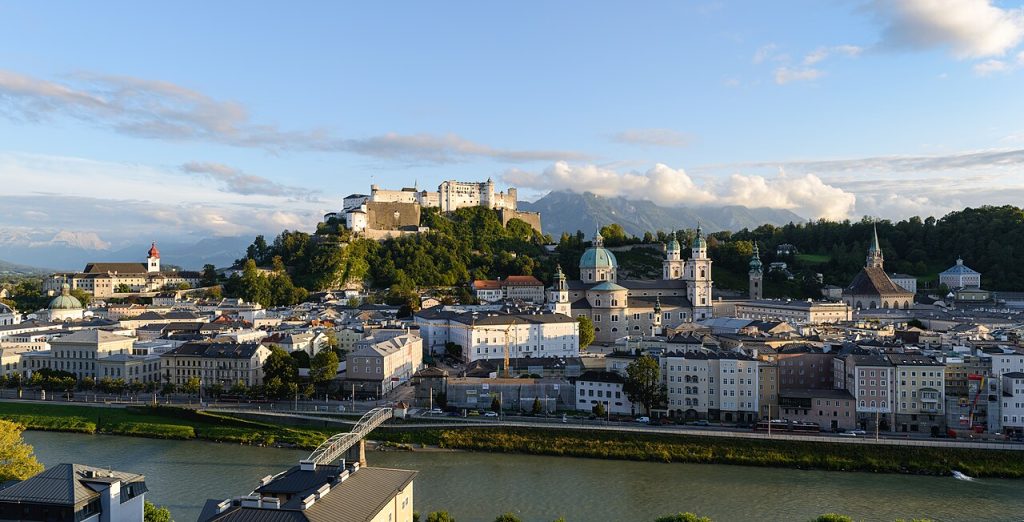

One day is enough to walk the heart of Salzburg, as long as you accept that you will meet the city rather than finish it. The plan below has four parts: the old town on the left bank in the morning, the right bank and the Mirabell gardens before lunch, Hohensalzburg Fortress in the afternoon, and the lit old town after dark. Three of the parts are walks of about two kilometers on mostly level streets; the fortress is shorter but climbs. All of it works with a map, a phone, or one of our audio guides.
The day at a glance
- Morning, about 90 minutes: the old town, from Mozartplatz to the Mozartsteg footbridge (about 2 km).
- Late morning, about 90 minutes: across the river, up the Steingasse and the Linzer Gasse to the Mirabell gardens (about 2.1 km).
- Afternoon, about 80 minutes plus any museums: Hohensalzburg Fortress, starting at the funicular station at Festungsgasse 4.
- Evening, about 90 minutes: an old-town walk after dark from the Waagplatz (about 2.3 km).
The times allow for stopping and looking. The four routes add up to about 7 km, before the walks between them and the detours nobody plans.
Morning: the old town on the left bank
Start at the Mozart statue on Mozartplatz and work west: Residenzplatz, the cathedral square, Kapitelplatz with its view up to the fortress, St. Peter’s Cemetery, the festival halls on Max-Reinhardt-Platz, the horse pond at Herbert-von-Karajan-Platz, Getreidegasse 9 (where Mozart was born in 1756), the Alter Markt, and finally the Salzach. It is about 2 km and close to flat: the only rise you will notice is the few meters up into the cemetery.
This is the route of our Salzburg Essentials audio guide, which ends in the middle of the Mozartsteg with the river running away on both sides.
Practical notes for the morning:
- St. Peter’s Cemetery has gates and hours. As published by St. Peter’s Abbey (read 5 October 2026), it opens at 6:30 and closes at 20:00 from April to September and at 18:00 from October to March. The catacombs in the cliff have their own hours and a small admission fee. If you are late, you can go round the cemetery through the cathedral square and the Franziskanergasse.
- Two steps lead into the cemetery from the mill yard.
- Cobbles cover about 400 meters: the mill yard, the cemetery, the abbey courtyard and the Alter Markt.
- Building sites. Mozartplatz has been under reconstruction since April 2026. The festival district is a building site: the new Festival Centre behind the horse pond has been going up since 2024, and work inside the Mönchsberg began in October 2026. The Neutor tunnel beside it is closed to traffic for about six months from 14 September 2026 but stays open on foot.
- Seasonal squares. The cathedral square carries a festival stage for roughly mid-June to early September, and the Christmas market takes over the cathedral square, Residenzplatz and part of Kapitelplatz from 19 November 2026 to 1 January 2027.
- Passages. We found no published hours for the covered passages between the Getreidegasse and Universitätsplatz. The Ritzerbogen arch and the Sigmund-Haffner-Gasse are public streets.
- Crowds. A city crowding study named the square in front of Mozart’s birthplace (Hagenauerplatz) as a bottleneck from May to October and in December.
Late morning: across the river to Mirabell
The right-bank end of the Mozartsteg is where Across the River begins. The route climbs gently through the Steintor and the cobbled Steingasse to the Platzl, up the Linzer Gasse to St. Sebastian’s Cemetery, down to Makartplatz, and through Mirabell Palace into the gardens. About 2.1 km, no admission needed.
At St. Sebastian’s, the Mozart family grave carries Leopold Mozart’s name, although the research we relied on suggests he is probably not buried in it.
Practical notes:
- The Steingasse has cobbles, no sidewalks, and one-way traffic that comes toward you as you walk toward the Platzl. Keep to the side.
- St. Sebastian’s Cemetery keeps shorter hours than St. Peter’s: the city’s leaflet gives 9:00 to 18:00 from April to October and 9:00 to 16:00 from November to March, and the tourist board lists slightly different times. Check the gate.
- Makartplatz is a construction site from 1 September 2026 for about three years.
- The Mirabell gardens are free. The City of Salzburg lists them as open 5:00 to 23:00 from April to September and 7:00 to 22:00 in the colder months (read 8 October 2026), with some parts closed in winter. The palace’s Marble Hall is usually free to visit at set hours, but it closes for weddings, events and renovation work, so check before you go.
- Steps: five steps out of the cemetery (avoidable) and 15 up to the dwarf garden. For a view, the Imbergstiege off the Steingasse climbs 250 to 260 steps to a lookout on the Kapuzinerberg; allow 20 to 25 minutes there and back.
Then find lunch: you have walked about 4 km.
Afternoon: Hohensalzburg Fortress
From the Mirabell gardens, walk back over the Marko-Feingold-Steg (the footbridge was called the Makartsteg until 2021), about 500 meters to the old-town bank, then through the old town to Kapitelplatz. The FestungsBahn valley station, Festungsgasse 4, is about 90 meters beyond the square’s south-west corner. Our Hohensalzburg Fortress audio guide starts outside it.
Two ways up: the funicular ride takes under a minute, and the footpath is about 500 meters with a climb of about 70 meters to the footpath ticket office, roughly a quarter of an hour at an unhurried pace.
Practical notes:
- You need a fortress ticket. As listed on the fortress’s own site (read 8 October 2026), the Basic ticket covers the funicular, the courtyards and bastions, the panorama tour and the museums, and the All-inclusive ticket adds the princely rooms and the Magic Theater. Walkers can buy cheaper footpath versions of both. Prices and contents change, so check the fortress’s ticket page before you go.
- Hours change with the season. As published on 8 October 2026, the fortress opens 9:30 to 17:00 from October to April and 8:30 to 20:00 from May to September, with last admission 30 minutes before closing. In winter, aim to be up by mid-afternoon. See the fortress’s opening-hours page.
- Funicular closures: 9 to 13 November 2026 (the museums and interiors close as well) and 11 January to 14 March 2027 (the footpath stays open).
- Not everything inside is step-free. The fortress says an elevator in the bell tower reaches the courtyard, the armory exhibition, the Kuenburg bastion and the marionette museum.
If you would rather go up first thing, start at the valley station when it opens and walk down to Mozartplatz afterward.
Evening: the old town after dark
Salzburg After Dark starts on the Waagplatz, about 140 meters from the Mozart statue, and was made for the evening. It runs about 2.3 km on lit streets with no mapped steps, crosses the river on the Staatsbrücke, and ends near the Mirabellplatz bus stops.
For more on what you will see, read our guide to Salzburg at night.
Sunset is about 16:19 in late December, 18:21 in mid-October and 21:12 in late June. Local press reports put the floodlight switch-off around 23:00 in winter and around midnight in summer, so a walk started an hour after sunset sees the buildings lit. That comes from press reports, not a published timetable.
Notes for the whole day
- Shoes matter more than the itinerary. Granite slabs and cobbles are slippery when wet or icy.
- Crossings: there are traffic lights at the riverside roads and at Herbert-von-Karajan-Platz.
- Hours and prices move. Check the venue’s own page on the day.
- None of this needs a guide. Every route here is on public streets, squares and bridges, so a map and a curious mood will do.
Where to go from here
If you would like to hear the story of the city as you walk it, our Salzburg tours follow these routes, and you can see them all with a map of where each one starts. How it works explains what you get on your phone. With a second day, a walk such as Salzburg 1938 to 1945 covers a part of the city’s story this plan leaves out. And if you would rather just walk, you now know where the steps and the closing gates are.