
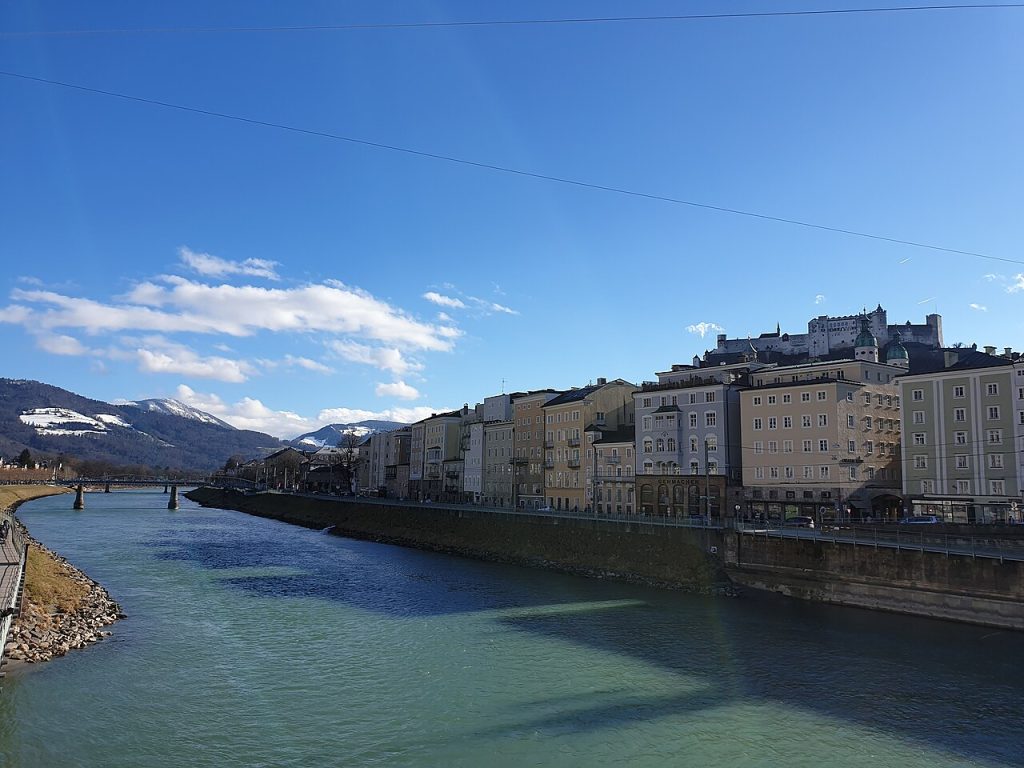

Yes, for most people, with one honest condition: from Munich it is an easy day, and from Vienna it is a long one. The fastest trains from Munich take about an hour and a half; the fastest from Vienna take about two and a half hours each way. The old town is a twenty-minute walk from Salzburg’s main station, and it is compact enough that a day gets you the cathedral squares, the Getreidegasse and, if you keep moving, the fortress. What a day does not get you is the lakes, the salt mines, or the city after dark.
The rest of this page is the arithmetic: how long the trains take, what fits between arrival and departure, and when a night in town earns its keep.
Getting there by train
Travel times below are the fastest ones published by Deutsche Bahn and by Salzburg’s tourism board. Many departures are slower, and timetables change, so check the planner for your date. Fares vary by train, time and how early you book; we link the operators rather than quote a price.
From Munich
Deutsche Bahn’s route page for Munich to Salzburg gives the fastest connection as 1 hour 27 minutes, with about 48 connections a day and up to 42 of them direct (as published on October 8, 2026). Salzburg’s tourism board, describing the same route, says “from 1h 40 min”, which is a fair reminder that the fast trains are not every train.
There is also a regional option: the Bayerische Regiobahn’s RE 5 (once branded Meridian) runs hourly from Munich to Salzburg main station via Rosenheim, Traunstein and Freilassing in just under two hours. It is slower, but it runs often and keeps the day simple if a faster train sells out or runs late.
Book or check times with Deutsche Bahn, ÖBB or the Bayerische Regiobahn.
From Vienna
Salzburg’s tourism board gives the Railjet Xpress from Vienna via St. Pölten and Linz as about 2 hours 25 minutes, with two Railjets an hour during the day. WESTbahn, a private operator, runs every half hour through most of the day from Westbahnhof or Hütteldorf, in about two and a half hours. If you are flying in, there is an hourly direct train from Vienna Airport, from about 2 hours 50 minutes.
That means roughly five hours on trains for the round trip. It can be done, and many visitors do it, but it changes what kind of day you are having. Times and fares: ÖBB and WESTbahn.
Arriving at Salzburg Hauptbahnhof
Long-distance and regional trains arrive at Salzburg Hauptbahnhof, the main station. It sits on the right bank of the Salzach, north of the old town. Salzburg’s tourism board puts the walk to the center at about 20 minutes. Trolleybus lines 1, 2, 3, 5 and 6 cover it in about 10 minutes if you would rather save your legs for the fortress hill.
The station has luggage lockers and a tourist information office, which is useful if you are carrying a bag between hotels. If you plan to use buses and enter several sights, the Salzburg Card includes travel on the city’s buses (not the S-Bahn); check its current price and what it covers against your own plan.
What fits into a day
Salzburg’s historic center is a UNESCO World Heritage site, and most of what people come to see sits within a short walk of the cathedral. Arriving around ten and leaving around six, a realistic day looks like this:
- The old town on foot, about two hours. Residenzplatz and the Domplatz, the cathedral, Kapitelplatz under the fortress, St. Peter’s, and the Getreidegasse with Mozart’s birthplace at number 9. You can do this with a paper map, a guidebook, or a self-guided audio walk such as Salzburg Essentials.
- Lunch, about an hour. Longer if you sit down somewhere popular.
- Hohensalzburg Fortress, two to three hours. Take the funicular from Festungsgasse, or walk up the path if your knees are willing. The funicular is closed for maintenance November 9–13, 2026 and January 11 to March 14, 2027; in those weeks the fortress is reached on foot. The views are the point, so go in good light. Our Hohensalzburg Fortress audio guide is one way to make sense of what you are walking through; the fortress’s own displays are another.
- The right bank on the way back. The Mirabell gardens are close to the route to the station, which makes them an easy last stop rather than a detour. If you want more of that side of the river, Across the River covers the Steingasse, the Linzer Gasse and Mirabell.
That is a full day, and a good one. It leaves out museum interiors beyond one or two; pick the one you care about most and accept that the others will wait.
If history is your reason for coming, Salzburg 1938 to 1945 happens to end at the main station, so it can double as your walk back to the train.
If you are coming from Vienna
Trim the plan. With five hours of rail around it, choose between the fortress and a slow afternoon in the old town rather than trying to do both at a run. The squares and the Getreidegasse alone make a satisfying day; the fortress rewards an unhurried visit more than a hurried one.
What a day trip cannot fit
Salzburg’s popular excursions are trips of their own, not add-ons:
- Hallstatt and the lakes. Organized tours from Salzburg are listed at about five and a half hours.
- The Eagle’s Nest and Berchtesgaden. Listed at about four and a half hours from Salzburg.
- Salt mine tours and Sound of Music bus tours to film locations outside the city. These also take a half day or more.
- Hellbrunn’s trick fountains. They are outside the old town, and they run only in season (March 28 to November 1 in 2026, per Hellbrunn).
- The evening. Concerts, a beer hall supper, and the old town after the day visitors leave. A day trip usually catches its train before any of that begins.
Any one of these can fill the time you would otherwise spend in the old town. If one of them is the real reason you are going, plan it as its own day.
When an overnight is worth it
Stay the night if any of these apply:
- You are coming from Vienna and want more than four or five hours on the ground.
- You want the fortress and the old town at an easy pace, plus a museum interior or two.
- You want an evening. A concert, dinner without watching the clock, or a walk through the lit lanes. Salzburg After Dark is built for that hour.
- You want one of the excursions above. Sleeping in Salzburg turns Hallstatt or Berchtesgaden into a morning start instead of a dawn one.
- It is December. The Christmas markets stay open into the evening, and in December the evening starts before half past four.
If none of those apply, a day trip from Munich is a sensible way to see Salzburg, and nobody should talk you out of it.
A few practical notes
- Check the return train before you leave. Know your last comfortable departure and work backward from it.
- Wear shoes for stone. The old town is paved, much of it in setts, and the fortress path climbs the whole hill.
- Expect crowds at the obvious places. A 2025 visitor-flow study for the city’s tourism board named the little square outside Mozart’s birthplace as a bottleneck from May to late October and in December. Go early or late if you can.
- Phones and maps both work. The old town is small enough that getting lost is brief.
Where to go from here
If you can stay longer, our one-day plan for Salzburg on foot shows how a full day fits together. If you are still deciding, our Salzburg page gathers what we know about walking the city. If you want to see how a self-guided walk works on your phone before you commit to anything, how it works explains it plainly. And if you would rather wander with a map and no plan at all, Salzburg is small and patient enough to reward that too.