

Salzburg’s old town is small and mostly flat, and most of what children enjoy is within walking distance of it. The hard parts are the hill with the fortress on top, the cobbles, and a few gardens that you reach by steps. Below is what works for families on foot, where a stroller goes and where it does not, and what to do when it rains.
Hohensalzburg Fortress: ride up
The fortress is the big draw for children, and the FestungsBahn funicular is half the fun. It starts at Festungsgasse 4, just off Kapitelplatz, a car leaves about every 10 minutes, and the ride takes under a minute.
With a stroller, the funicular is the way up. The fortress says its footpath is steep, partly gravel, has steps in places and is not suitable for baby carriages, and that step-free access is possible only by the FestungsBahn. The FestungsBahn says it carries strollers free when there is room. At the top, the terrace by the station is step-free, and an elevator in the bell tower reaches the castle courtyard and the Marionette Museum. Most of the other museums are not reachable with a stroller; the fortress says you can park it at the Info Point and lock it with your own lock.
With children who like to climb, walking up is an option: the fortress gives 15 to 30 minutes for the path, depending on which of its pages you read. The footpath tickets include the ride down.
What children tend to look for up there:
- The Marionette Museum, in the vaulted gun gallery cut into the rock, with historic puppets from the Salzburg Marionette Theatre.
- The turnip. Archbishop Leonhard von Keutschach put a turnip in his coat of arms, and it turns up all over the fortress. Children like the legend behind it: a lazy pupil, an angry uncle, and a turnip thrown after him. Salzburg’s local encyclopedia says the legend was invented in the late 1800s, and the turnip was on his family’s arms by 1344, a century before he was born. Counting turnips works either way.
The Panorama tour climbs a tower by stairs and is not step-free. Children pay less; see the fortress’s ticket page and our guide to fortress tickets.
Plan around two closures. As published on 8 October 2026, the funicular is closed 9 to 13 November 2026 (museums and indoor areas closed too) and 11 January to 14 March 2027. In the second window the footpath is the only way up, so there is no stroller access.
Mirabell: dwarfs, a hedge theater and a playground
Across the river, the Mirabell gardens are free. The City of Salzburg lists them as open 5:00 to 23:00 from April to September and 7:00 to 22:00 in the colder months (as published on 8 October 2026), with partial closures in winter.
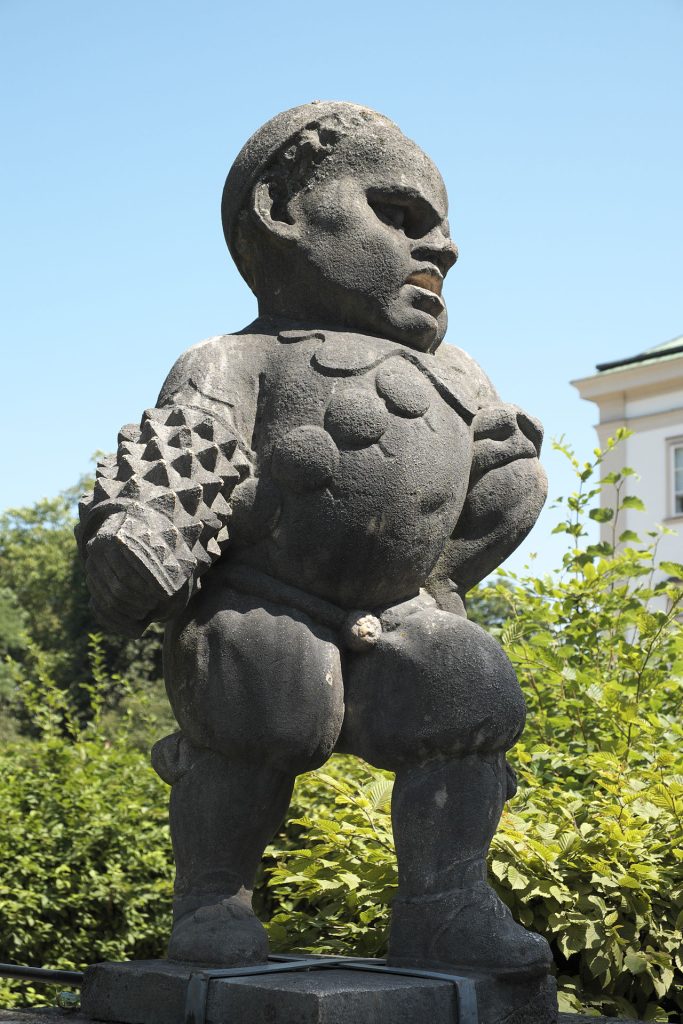
The dwarf garden is the part children remember: marble dwarfs from the 1690s, which the city calls the oldest dwarf garden in Europe as far as is known. They were auctioned off in 1811 and tracked down again after 1919, and some still stand in private gardens. It is 15 steps up from the Pegasus fountain and not step-free, and the dwarfs are boxed in wooden cases in winter.
Nearby are the hedge theater, which the city says is the only one of its kind in Austria, and just below it the city’s Zauberflötenspielplatz, a playground built in 2006 around scenes from Mozart’s The Magic Flute. The city lists drinking water and a toilet nearby.
The west end of the old town: toys, fish and a riverside playground
Three things for children sit within about 400 meters of each other at the western end of the old town.
- The Toy Museum (Spielzeug Museum), Bürgerspitalgasse 2, is aimed at children up to about 10, with play areas and toys to use. It is step-free with an elevator, has stroller parking by the ticket desk, changing tables on every floor and snack areas on every floor where you may eat your own food. As published on 8 October 2026, it opens Tuesday to Sunday, 9:00 to 17:00, with last entry at 16:00. Museum page.
- Haus der Natur, Museumsplatz 5, is the natural history museum: aquarium, reptile zoo, dinosaurs, a hands-on Science Center and a Christian Doppler exhibition. Strollers up to 110 by 65 cm may go in; larger ones stay in the foyer. An elevator serves every floor. As published on 8 October 2026, it opens daily 9:00 to 17:00. Hours and prices.
- The Franz-Josef-Kai playground in Mülln, by the river, is on the city’s playground list, with drinking water.
Children pay less at both museums; see their pages.
Hellbrunn’s trick fountains, in season
Hellbrunn Palace, south of the center, has water-powered grottoes and fountains that spray visitors who are not paying attention. It is about 25 minutes on bus line 25 from the Rathaus stop. As published on 8 October 2026, the 2026 season runs 28 March to 1 November, and the visit takes about 50 minutes. Hellbrunn says you get wet “only if you wish to”, that it opens in any weather, and that the park and the trick fountains are wheelchair accessible. The palace gardens have a playground with a step-free toilet beside it. Children pay less; see Hellbrunn’s hours and prices.
Strollers, steps and toilets
- Cobbles cover parts of the old town, and the Steingasse on the right bank is cobbled with no sidewalks. The riverside promenade at the right-bank end of the Mozartsteg is smooth asphalt; watch for cyclists on the Giselakai.
- Steps to know about: the fortress footpath, the 15 steps to the dwarf garden, and two steps at the gate into St. Peter’s Cemetery.
- Toilets we could source: OpenStreetMap shows public toilets by the cathedral’s south arches near Kapitelplatz; there are also toilets by the Info Point and in the restaurant at the fortress, near the Mirabell playground, inside Haus der Natur and the Toy Museum, and by the Hellbrunn playground.
How long little legs last
Each of our old-town routes is about 2 km, and that is a fair morning for a small child once you add stopping and a snack. If they flag, a playground or a museum with a play area is never far. A gentle shape for the day: one walk in the morning, the fortress or a museum after lunch, and nothing ambitious after that. Our Salzburg in one day plan has all four walks and is a lot for young children; take half.
When it rains
The Toy Museum and Haus der Natur are the obvious choices. The fortress museums, including the Marionette Museum, are indoors, though getting between them is not. Hellbrunn’s trick fountains run in any weather, and you may get wet there anyway. In winter, Hellbrunn’s fountains are closed and the Christmas markets take over; see Salzburg in December.
Our audio tours and children: an honest fit
Our tours were not made for children, and there is no children’s version. Salzburg Essentials, Across the River and Hohensalzburg Fortress are history walks of about 80 to 90 minutes, made for adults and older teenagers. Older children with an interest in castles or Mozart may enjoy them; younger ones may last a few stops. Each booking includes 2 phones, a group can add phones or share one on its speaker, and you can pause anytime, so a parent can listen while a child runs around the dwarf garden. The fortress tour includes sieges and the story of a dungeon, and Across the River has a stop in the dwarf garden.
Two tours are not for young children. Salzburg After Dark carries a content advisory for descriptions of torture and of the execution of children in the sorcery trials, and Salzburg 1938 to 1945 for persecution and murder. Parents can judge for teenagers.
You can see where each tour starts, and how it works explains what you get on your phone.